Sunday, 19 January 2014

Freud museum

Helen Chadwick


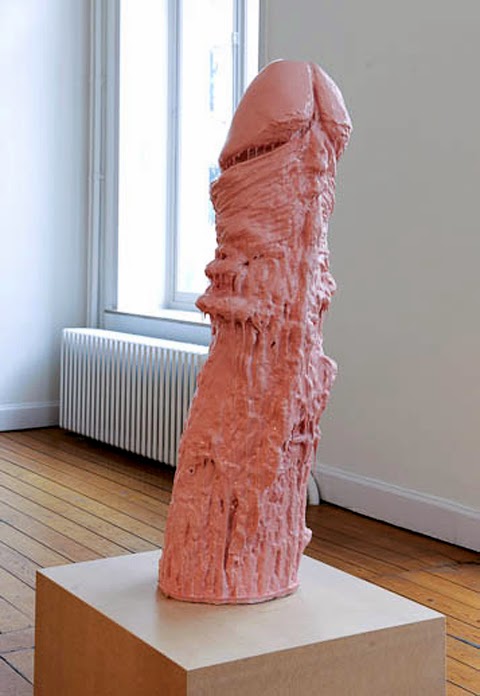
Iza Genzken
 Louise Bourgeois


Images

Here is images i took from the internet


Louise Bourgeois

drawings


psychoanalytic thinking


Shame, which is a powerful and painful emotion, suddenly occurs in its onset and exerts a powerful influence on behaviours by reaching overwhelming proportion. As considering when shame takes place, shame mainly does in relation to an external referent as well as an internal one.

Yorke(2008) had a doubt if it is ever completely internalized and then adds that ‘There is always an awareness of an observer, a possible observer, a former observer, or fantasized observer.’(yorke 2008 p36). Namely, the fact that I feel ashamed even when alone is related to sensing observers though they are invisible. A feeling that someone may be looking at me leads to fear of exposure that leads to a sense of guilt by being disapproved and condemned. The observer for me is my parent. I even find it difficult to keep eye contact with them after doing something sexual.

The awareness of an observer partly reflects a link between shame, pride, exhibitionism-voyeurism and the defenses against it that underlie the need to hide. This calls for elaboration in developmental terms of oral, urethral, anal and phallic exhibitionism. (Yorke 2008 p36)

In my view, the observers as a measure of forming self-esteem or self-evaluation can be a reason of shame, and the shame is a defensive reaction against being repressed by social derivatives to meet with the idealization in the ego. Yet, extremely underlying education about sexuality rather deprives me of sexually self-indulgent pleasure.

Narcissistic exhibitionism instinctively placed ends up leading to shame because a feeling of physical inferiority derived from penis envy represses the wish. That is, despite this body of mine, a sense of inferiority elicited from envying what I cannot have in superego causes shame when i am shown instinctively or even intentionally. Shame of the narcissistic component can be applied to the situation in that I am not willing to stare at my own genital because it makes me ashamed without any reason. I think that the theory of penis envy seems somewhat useful to understand it. 
Bibliography
Yorke,C,B.(2008) A Psychoanalytic Approach To The Understanding Of Shame In: Pajaczkowska,C. & Ward,I.(2008) Shame And Sexuality: Psychoanalysis And Visual Culture , London:Routledge


Shame, Abjection and Disgust

There are remarks of books i read 
'It is not an object, not even a coherent object of study. Shame, which is the greater part of the experience of abjection, being precisely where words fail us and where the difference between self and not-self ceases to exist' (Kristeva 1982 referenced in Pajaczkowska and Ward 2008)

Kristeva suggests, the abjection is the place at which the origins of self are found in the act of differing from 'mother', so that anything that threatens to revoke or dissolve that difference invokes abjection.

We invoke the world of verbal language, words in syntax: thought, spoken or written. Because of its agency in the formation of the eariest, preverbal representations of the self, shame refers us to a relationship to representation based on iconic signs and visual, spatial logic that precedes the word and its syntactical language of time and grammatical subject.

 Anthropologist Mary Douglas describes this transgression of symbolic borders as our experience of 'contamination', and defines the objectification of this feeling as 'dirt'. The many anxieties that are produced by the fear of contamination by dirt give rise to complex rituals and taboos, the observance and repetition of which are believed to have magical powers of cleaning, cure, salvation or restoration of symbolic boundaries.
Julia Kristeva concluded the function of these religious rituals is to ward off the subject's fear of his very own identity sinking irretrievably into the mother.

sexual instinct has to struggle against certain mental forces which act as resistances, and of which shame and disgust are the most prominent. It is permissible to suppose that these forces play a part in restraining that instinct within the limits that are regarded as normal.


On the other hand, these forces which act like dams upon sexual development-disgust, shame and morality-must also be regarded as historical precipitates of the external inhibitions to which the sexual instinct has been subjected during the psychogenesis of the human race. 


We can observe the way in which, in the development of individuals, they arise at the appropriate moment, as through spontaneously, when education and external influence give the signal.


A chapter 6 of Art and Psychoanalysis (Walsh 2013)

The Evolution of Abjection

The potential of pre-Oedipal primary processes, which includes the bodily drives and affects, is a source of creativity which can be tapped into on in other to restructure the symbolic rigidity of culture.(p68)

The pre-Odepal primary processes of the semiotic are linked to the basic pulsion of early development which are predominantly anal and aril. For kristeva, these pulsions are gathered up in a space she calls the chora, a term she appropriates from Plato's Timaeus, where 'he defines it as an enclosed womb-like space which at the same time is "an invisible and formless being" capable of receiving all things and partaking of the intelligible.(p68)

Chadwick's work explores the intersubjectivity of semiotic space in artworks that exemplify it as a space of potential for the creation of multiple self-doublings by which the woman constitutes her subjectivity anew, beyond castration. this is a spece where she can enter into a self-conscious splitting, not between belief and disbelief, as the fetishist does, but between self and self-other in which the self contains the split-off parts of itself rather than projecting them outwards.(p71)


Robert Gober & Sarah Lucas


Penny Siopis


Penny Siopis

Three Essays on Shame (4 June 2005-10 July 2005)

Penny Siopis is one of the most influential artists working in South Africa today. Her career, spanning 30 years, includes her well-known ‘history’ paintings of the 1980s that critiqued apartheid, and subsequent installations and films that explore personal memory in the post-apartheid era. Her wide-ranging multi-media exhibition at the Freud Museum,Three Essays on Shame, celebrated the centenary of theThree Essays on Sexuality (1905) by grafting present-day South African social circumstances onto Freud’s work and milieu. Through the display of paintings and objects that reference Freud’s work, the artist was able to explore the significance of shame in wide cultural themes.
The exhibition was comprised of three interventions into the intimate spaces of Freud’s house. In Freud’s famous study the artist situated seven audio recordings of South African personalities who have all publicly expressed feelings on or about shame. Antjie Krog, author of Country of my Skull(describing her experience as a reporter for the Truth and Reconciliation Commission) reflects on this experience as well as more personal aspects of shame. Edwin Cameron, judge and AIDS and Gay activist, speaks of his personal experience of being HIV positive in the context of the pandemic of AIDS in Africa. Fatima Meer, well-known sociology professor and detainee of the apartheid regime, describes the torture of her political detention as well as more personal memories of ‘shame’, while Paul Verryn, Bishop of the Methodist Church of Johannesburg, and activist priest in the apartheid era, speaks of his personal role in the Truth and Reconciliation hearings.

The second intervention, installed in Freud’s dining room, incorporated a series of objects, artworks and film combined to orchestrate a chain of cultural and psychological associations reflecting the psych-sexual state of shame in its broader cultural context. A terracotta figurine (right) in Freud’s collection of antiquities is the trigger for these associations, and is displayed as the keystone if this part of the installation. The figurine (probably of Egyptian origin) depicts a woman in a squatting pose, exposing her genitalia, with one hand gesturing towards the site of exposure. This provocative pose is identified with the character of Baubo of Greek mythology. One of the films included in the installation, To Walk Naked, is a short documentary about a particular instance in apartheid South Africa in which a group of black women stripped in from of white policemen intent on bulldozing their homes, using their nakedness ad ‘shame’ as a weapon of resistance.
The third installation was comprised of paintings and found objects including personal items belonging to Freud. These works, which give form to the imaginative realm of shame, conceptually condense all the complex and contradictory qualities of shame as it specifically relates to sexuality.
A wide range of disciplines and fields of human knowledge, including psychology, politics, anthropology, art and literature, explore the concept of shame, and, like Freud himself, the artist drew on these disciplines in the structure and content of her exhibition.
(Freud museum2005 )


Her engagement with shame began in 2000 as an ongoing series of small 'shame' paintings and installation of found objects, all of which she expanded in her multimedia exhibition Three Essays on Shame(2005) It was taken the form of an intervention in the Freud Museum in London.

She wanted to ponder there on how shame came to 'breathe' in her intervention in the Freud house.
She also wanted to rather to give a strong sense of what stimulated and energized this intervention in its complexity, and to stress the power and potential of unruly, animated 'association' over stabilizing narrative or analysis.

The shame series is painted by thickly applying oil paint to create almost 3 diminutional forms and almost tactile texture to explore her interest in prejudice, shame and 'moral panic'.

The predominating colours are pink and red.  The effect created by these techniques makes the paintings feel alive with a close reference to flesh and skin. She explains her choise of medium by saying. 

"Paint acts as flesh :  It dries slowly, and is moist underneath for years. Eventually it cracks and wrinkles."
(Visual Art Theory Artists 2013)

available from http://nladesignvisual.wordpress.com/2013/08/03/penny-siopis/
Powered by Blogger.